
 JobTime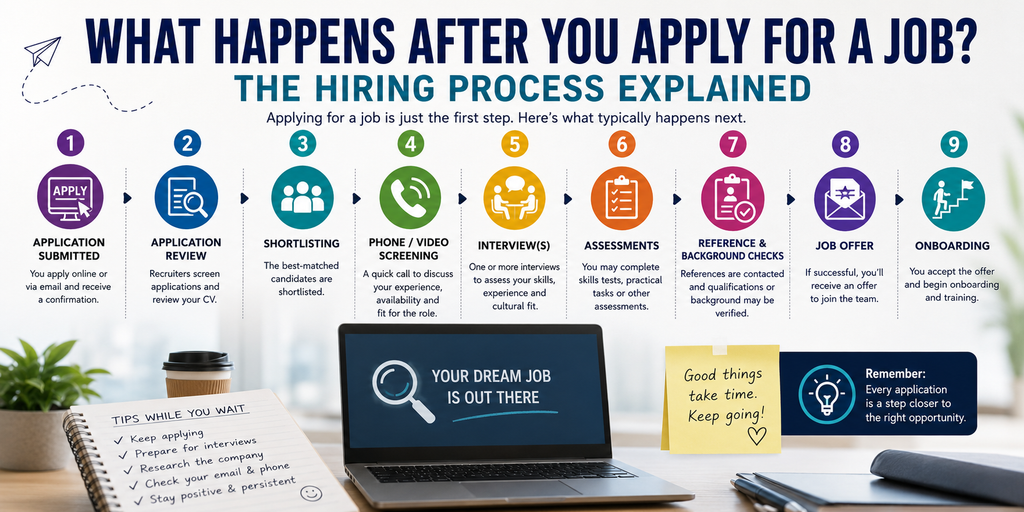
You find a job that looks perfect for you.
You read through the requirements, update your CV, complete the online application and finally click “Submit Application.”
Then comes the difficult part: waiting.
The first day passes. Then three days. A week later, you still haven’t heard anything.
You start wondering:
Did they receive my CV?
Has somebody actually read my application?
Does “Under Review” mean I still have a chance?
Why haven’t they called me?
Should I follow up, or will that make me look desperate?
If you’ve ever applied for jobs, you’ve probably experienced this uncertainty.
The reality is that quite a lot can happen behind the scenes after you submit a job application. Your CV may go through initial screening, recruitment software, a recruiter, a hiring manager and several rounds of shortlisting before you ever receive a telephone call.
And even after an interview, the process may continue with assessments, additional interviews, references, qualification verification and other checks before an employer decides who gets the job.
This guide explains what happens after you apply for a job, what each stage of the hiring process means and what you can do while waiting.
The first thing that happens depends on how you applied.
Today, applications may be submitted through:
If you applied online, your application will normally be recorded in the employer’s recruitment system.
You may receive an email almost immediately saying something like:
“Thank you for applying. Your application has been successfully received.”
This is good because you know the application went through.
But don’t confuse an acknowledgement email with being shortlisted.
In many cases, nobody has read your CV yet.
The email was generated automatically because the system received your application.
Your CV may then wait in the system until a recruiter begins reviewing applications.
Some companies review applications as they arrive. Others wait until the vacancy’s closing date.
This explains why one employer might contact you the following morning while another doesn’t contact candidates for two or three weeks.
Imagine you’re applying for one administrative assistant vacancy.
You’re probably not the only person interested.
There could be dozens or even hundreds of applicants depending on the employer, location, salary and type of position.
The employer now has a problem:
How do we identify the strongest candidates from all these applications?
That’s where the recruitment process begins.
The employer may collect information including:
This is why completing an application form properly matters even when you’ve already uploaded a CV.
Don’t assume the recruiter will ignore the form and only read your CV.
If the application asks:
“Do you have a valid Code 10 driver’s licence?”
answer accurately.
If it asks:
“How many years of customer service experience do you have?”
don’t automatically select the highest number because you think it improves your chances.
Your answers may be compared with your CV later.
Before deciding who deserves an interview, employers usually need to eliminate applications that clearly don’t meet essential requirements.
This is sometimes called initial screening.
Let’s say a vacancy requires:
A recruiter may begin by checking whether applicants meet these basic requirements.
Candidates who clearly don’t meet mandatory requirements may not progress.
This is why reading a vacancy carefully before applying is so important.
The South African Government’s job-seeker information explains that applicants compete with other job seekers and provides resources covering CVs, interviews and finding work.
Useful resource:
South African Government – Finding a Job
Don’t interpret this to mean that you need to match every single sentence in every advertisement.
Employers often distinguish between:
Essential requirements – things you genuinely need to perform or qualify for the job.
and
Preferred requirements – things the employer would like but may potentially compromise on.
For example:
Essential: Matric.
Preferred: Previous retail experience.
Someone without Matric may fail to meet the minimum requirement.
Someone with Matric but no retail experience might still have a chance if they demonstrate relevant customer service, communication or transferable skills.
You may have heard people saying:
“The ATS rejected my CV.”
ATS stands for Applicant Tracking System.
These systems help employers manage job applications.
Imagine trying to manage 1,500 CVs arriving through random emails.
It would become chaotic very quickly.
Recruitment systems help companies organise applicants, track their progress and make applications easier for recruiters to manage.
Depending on the system and employer, recruiters may be able to search and organise applications using information such as:
This is one reason your CV should use straightforward language.
If you have Microsoft Excel experience, for example, don’t simply write:
“Good with computers.”
Say what you can actually do.
For example:
Microsoft Excel – experienced in capturing data, maintaining spreadsheets and preparing weekly reports.
The second description is more useful to a recruiter and more clearly explains your skill.
At some point, the applications that remain under consideration will normally require human review.
Now your CV needs to make sense to an actual person.
Think about the recruiter’s situation.
They may have spent hours reading applications.
Then they open yours.
What can they understand within the first part of your CV?
Can they immediately identify:
This is why a simple, relevant CV can sometimes outperform a beautiful but confusing one.
Recruiters generally aren’t looking for the CV with the fanciest graphics.
They’re trying to answer:
“Could this person potentially do this job?”
Let’s say you’re applying for a customer service position.
The employer might look for evidence that you’ve:
Simply writing:
“I am a hardworking person.”
doesn’t prove any of these things.
A better CV gives evidence.
For example:
“Handled customer enquiries by telephone and email, resolved account queries and escalated complex complaints to the appropriate department.”
Now the recruiter understands what you’ve actually done.
After screening applications, the employer starts creating a shortlist.
This is an important stage.
Being shortlisted essentially means:
“We think this person may be worth interviewing or assessing further.”
Imagine 500 people applied.
The process might look something like this:
500 applications received
↓
150 meet the basic requirements
↓
50 have strongly relevant experience
↓
15 are seriously considered
↓
8 are invited to interviews
↓
3 reach the final stage
↓
1 receives the offer
Those numbers are only an illustration. Every employer and vacancy is different.
But they demonstrate something job seekers often forget:
You’re also competing against other applicants.
You may be perfectly capable of doing the job and still not be shortlisted because another applicant’s experience matches the vacancy more closely.
This is one of the most frustrating parts of job hunting.
You read the vacancy and think:
“I can do everything they’re asking for.”
Yet you never receive a call.
That doesn’t necessarily mean the employer thought you were incapable.
There are many possible explanations.
Another applicant may have had more directly relevant experience.
The employer may have received an exceptionally strong pool of applications.
An internal candidate may have applied.
The position may have changed.
The recruitment process may have been suspended.
Your CV may not have communicated your experience clearly enough.
You may also have overlooked an essential requirement.
Rather than becoming discouraged after one rejection, look at your results over multiple applications.
If you’ve submitted 30 carefully targeted applications and received zero responses, review your CV and application strategy.
If you’re getting interviews but no offers, focus more heavily on your interview performance.
That’s much more useful than assuming:
“Nobody wants to hire me.”
Then one afternoon your phone rings.
You answer.
“Hi, may I speak to Thando? I’m calling from ABC Company regarding the customer service position you applied for.”
This may be your first real interaction with the employer.
And yes, it matters.
Some recruiters use a short telephone conversation before inviting applicants to formal interviews.
They may want to confirm:
Don’t treat this call casually simply because the recruiter hasn’t called it an interview.
It may effectively be your first interview.
Maybe you’re standing inside a busy taxi rank.
Maybe you’re currently at work.
Maybe you’re collecting your child from school.
You don’t need to conduct an important employment conversation while shouting over background noise.
Politely say something like:
“Thank you for calling. I’m very interested in the position. I’m currently somewhere quite noisy. Would it be possible for me to move somewhere quieter, or could we arrange a suitable time for the call?”
That’s far better than repeatedly saying:
“Sorry? What did you say?”
Getting an interview is a positive sign.
It means you’ve already made it through part of the selection process.
Now the employer wants to learn more about you.
Interviews can take place:
The Western Cape Government recommends researching the company before an interview, understanding its goals and values, knowing yourself and preparing questions. (Western Cape Government – Preparing for an Interview)
This is excellent advice because one of the easiest ways to look unprepared is being unable to answer:
“What do you know about our company?”
You don’t need to memorise the company’s entire history.
But you should understand:
An interview isn’t only about answering questions “correctly.”
The employer is trying to imagine you doing the job.
They’re assessing things such as:
Can you explain your thoughts without becoming completely lost?
Have you actually read the vacancy?
If your CV says you’ve supervised 15 employees, can you explain what that involved?
Employers often ask about real situations because previous behaviour can provide useful insight into how someone approaches work.
Arriving without knowing the job title isn’t a great start.
Professional doesn’t mean pretending to be someone else.
It means treating the opportunity seriously.
Some jobs require practical testing.
This makes sense.
A CV can say:
“Advanced Microsoft Excel.”
But can you actually use Excel?
An employer may want to find out.
Depending on the job, assessments might include:
For example, an administrative applicant might be given a spreadsheet and asked to organise data.
A customer service applicant might be given a scenario involving an angry customer.
A writer may receive a short writing assignment.
A manager might be asked to analyse a business problem and explain how they would respond.
This is another reason never to exaggerate your skills on your CV.
Eventually, someone may ask you to demonstrate them.
You finish your interview and feel relieved.
Then two days later you receive another call:
“We’d like to invite you back for a second interview.”
This is usually another positive sign.
The company is investing more time in assessing you.
The first interview might have been conducted by HR.
The second could involve:
The questions may also become more detailed.
Instead of:
“Do you have leadership experience?”
you could be asked:
“Tell us about a time one of your team members wasn’t meeting expectations. What did you do?”
Prepare real examples from your career.
This is the stage many candidates never see.
You leave your interview thinking:
“That went really well.”
And you may be right.
But somewhere inside the company, several people could now be discussing you and the other candidates.
Imagine three finalists.
Eight years’ experience but weaker interview.
Four years’ experience, excellent interview and highly relevant technical skills.
Six years’ experience, strong interview but higher salary expectations.
Who gets hired?
There’s no universal answer.
The employer has to decide which combination best meets its needs.
This is why a great interview doesn’t guarantee a job offer.
Sometimes you did well.
Someone else simply matched the position slightly better.
If you reach the final stages, the employer may contact your references.
This could include a former:
Choose references who actually know something about your work.
Don’t simply list someone because they have an impressive job title.
Also ask permission first.
Imagine your former manager receiving a call:
“Hello, we’re calling because Sipho listed you as a reference.”
and responding:
“He did?”
Not ideal.
Keep your references’ contact details updated.
Some positions involve additional verification.
The checks depend on the employer and the role.
For example, UCT’s recruitment information says it may verify references and qualifications and conduct criminal checks, with credit checks for certain positions. (UCT Jobs)
This is a good reminder that different jobs can involve different screening requirements.
A role involving driving might require verification of a driver’s licence.
A regulated profession may require professional registration.
A position involving financial responsibility may involve different checks from an ordinary entry-level position.
Tell the truth on your application.
Don’t turn:
“Completed two years of a degree”
into:
“Bachelor’s degree completed.”
Don’t invent previous employers.
Don’t change your job title from cashier to “Regional Retail Operations Manager.”
Recruitment can involve verification.
Honesty is much safer than trying to make your CV look artificially impressive.
This is the call everyone is waiting for.
“We’d like to offer you the position.”
Fantastic.
But don’t become so excited that you stop paying attention.
A job offer should be understood properly.
Look at important details such as:
If something isn’t clear, ask.
You are allowed to understand what you’re agreeing to.
And if you’re currently employed, be careful about resigning purely because someone casually said:
“The job is yours.”
Make sure you understand the formal offer and any conditions attached to it.
Potentially.
Not every employer has flexibility, particularly where salaries are fixed according to established grades.
But in other cases, there may be room for discussion.
You might discuss:
Keep the conversation professional.
Instead of:
“That’s too little. I want R5,000 more.”
you could explain your position respectfully and ask whether there is flexibility in the package.
Also remember that salary isn’t the only consideration.
Think about:
A slightly higher salary isn’t automatically a better job if getting to work costs you significantly more every month.
Once you’ve reviewed the offer and you’re happy with the terms, you can formally accept it according to the employer’s instructions.
If you’re already employed, you’ll usually need to handle your resignation professionally and comply with the applicable notice arrangements.
Keep important correspondence.
Create a folder for:
You’ll thank yourself later when HR asks for something you submitted three weeks earlier.
Before starting work, HR may ask for additional information.
Depending on the employer and position, this may include legitimate employment and payroll documentation.
But this is also the stage where job seekers need to remain alert to scams.
The South African Department of Employment and Labour has specifically warned work seekers not to pay fees for employment services, stating that work seekers should not be charged for placement services. (Department of Employment and Labour – Work Seekers Warned Not to Pay for Employment)
That’s worth remembering.
If someone tells you:
“Congratulations, you’ve been selected. Pay R350 to secure your position.”
stop.
Verify the employer independently.
Job scams can look surprisingly convincing.
Scammers may use:
The Department of Employment and Labour has warned about fraudulent job opportunities where criminals misuse official branding and request payments for employment processing or training. (Department of Employment and Labour – Fraudulent Job Opportunities Warning)
Red flags can include:
If you’re unsure, don’t use the telephone number provided by the suspicious person to verify them.
Find the organisation’s official website yourself and use its published contact information.
You made it.
Your first day arrives.
You may feel excited and terrified at the same time.
That’s normal.
Even someone with 20 years of experience needs time to understand a new workplace.
Onboarding may include:
Don’t feel pressured to know everything immediately.
Ask sensible questions.
Take notes.
Learn people’s names.
Pay attention.
And don’t be embarrassed to ask:
“Could you please show me that again?”
It’s much better to ask than pretend you understand and repeatedly make the same mistake.
Unfortunately, there’s no magic number.
A company could hire someone within a few days.
Another organisation could take more than a month.
A hypothetical timeline could look like:
Week 1: Applications received.
Week 2: Screening and shortlisting.
Week 3: First interviews.
Week 4: Assessments or second interviews.
Week 5: References and final decisions.
Week 6: Offer.
But don’t treat this as a rule.
Recruitment timelines vary considerably.
This is where job seekers often torture themselves.
You interviewed on Monday.
By Wednesday you’re checking your phone every ten minutes.
Friday comes.
Nothing.
Your brain immediately says:
“I didn’t get it.”
Maybe.
But maybe not.
Recruitment can be delayed because:
Silence doesn’t always equal rejection.
Unfortunately, silence doesn’t guarantee good news either.
That’s why the healthiest strategy is:
Sometimes, yes.
A polite follow-up can be appropriate.
But read the advertisement first.
If it says:
“Only shortlisted candidates will be contacted,”
respect that.
If there is a closing date, don’t email the recruiter the morning after you apply asking:
“Any update?”
Give them time.
When following up, keep it simple.
For example:
“Good morning. I submitted an application for the Administrative Assistant position on 12 August and wanted to enquire whether there has been an update regarding the recruitment process. I remain very interested in the opportunity. Thank you for your time.”
That’s enough.
Don’t send:
Monday: Any update?
Tuesday: Hi?
Wednesday: ???
Thursday: Please respond.
That won’t improve your application.
It means exactly that.
The employer may contact only the candidates progressing to the next stage.
If 800 people apply, sending 799 personalised rejection emails may not be practical for that organisation.
It can be frustrating.
But don’t wait indefinitely for closure.
Continue searching.
If your application status says Under Review, it generally means the application hasn’t been marked as completed or unsuccessful within that particular recruitment system.
It doesn’t necessarily mean:
“You’re getting an interview.”
And it doesn’t necessarily mean:
“You’ve been rejected.”
Different recruitment platforms use status labels differently.
You may see:
Don’t spend hours trying to decode every status change.
No.
This is one of the most important lessons in job searching:
Even a fantastic interview isn’t an offer.
Even a second interview isn’t an offer.
Keep applying until you’ve secured a suitable opportunity.
Think about it this way.
You interview with Company A on Monday.
You stop applying because you’re convinced you got it.
Company A takes three weeks to make a decision.
Then they choose someone else.
You’ve just lost three weeks of job-search momentum.
Continue looking.
Waiting doesn’t mean doing nothing.
Use the time productively.
If they call you tomorrow, you should know who they are.
Practice answering:
The City of Cape Town’s career guidance recommends researching employers and preparing real examples that demonstrate relevant competencies. (City of Cape Town – Career Advice and Support)
If you miss an unfamiliar number, check whether they left a message.
Including your spam folder.
Probably the most important one.
You don’t have to rely entirely on random social media posts for career information.
The South African Government provides a Finding a Job resource containing information about job hunting, CVs, interviews and government vacancies.
The Department of Employment and Labour also operates Public Employment Services, which includes registering work seekers and matching work seekers with available opportunities.
You can read more through the Department of Employment and Labour Public Employment Services.
Students and graduates may also have access to university career services. For example, the University of Cape Town Careers Service provides career resources, application support, employment opportunities and career consultations for eligible students.
Use trusted resources alongside your own job search.
There is no fixed timeline. Some employers contact candidates within days, while others take several weeks. A closing date may also mean serious shortlisting only begins after applications close.
No. It usually confirms that your application was successfully submitted.
Possibly, but not necessarily. Recruitment systems use statuses differently.
They generally consider how well applicants match the position’s requirements, including experience, qualifications, skills and other role-specific criteria.
Meeting the minimum requirements doesn’t guarantee an interview. Other candidates may have had more relevant experience or qualifications, and employers may receive many suitable applications.
Absolutely.
One rejection doesn’t mean the company will never employ you.
A future vacancy may suit your experience much better.
Be extremely cautious about anyone asking a work seeker to pay for employment placement. The Department of Employment and Labour states that work seekers should not be charged fees for employment services. Verify recruitment agencies and offers carefully.
It may not be described as a formal interview, but you should treat it seriously because the recruiter may use it to decide whether you progress.
Yes.
Until you’ve secured a suitable offer, continue exploring opportunities.
Clicking “Submit” isn’t the end of your job application.
It’s the beginning of a process you mostly can’t see.
Your application may first enter a recruitment system.
It may then be screened against the job’s requirements.
A recruiter may review your CV.
A hiring manager may compare you with other candidates.
You could then move through telephone screening, interviews, assessments, references and other checks before an offer is finally made.
Sometimes this happens quickly.
Sometimes it takes weeks.
And sometimes you never receive a response.
That’s the frustrating reality of job hunting.
But understanding the process gives you something valuable: perspective.
You don’t have to interpret every quiet day as rejection.
You also don’t have to sit around waiting for one employer to decide your future.
Keep improving your CV.
Keep preparing for interviews.
Keep checking that the jobs you’re applying for are legitimate.
Keep learning from unsuccessful applications.
And most importantly:
Keep applying.
Your job search doesn’t end because one company hasn’t called.
Every well-targeted application gives you another opportunity to reach the next stage — and eventually, one of those applications may be the one that leads to the call you’ve been waiting for.








 📢 Get Job Alerts on WhatsApp
 Home
Home View all posts
 Post a Job