 JobTime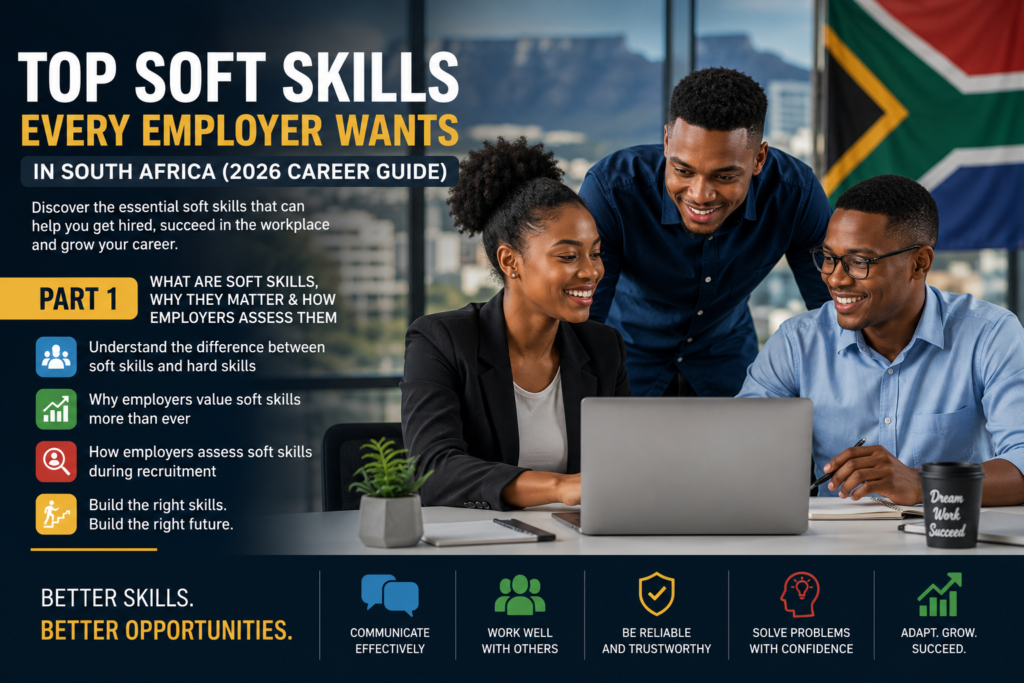
Getting hired in today’s job market requires more than simply having the right qualification or technical knowledge. While degrees, diplomas, certificates, and practical experience remain important, employers are increasingly looking beyond what’s written on a CV. They want people who can communicate effectively, work well with others, solve problems, adapt to change, and contribute positively to the workplace.
These qualities are known as soft skills, and they have become some of the most valuable attributes employers look for when recruiting new staff.
Whether you’re applying for your very first job, changing careers, or hoping to move into a more senior position, developing strong soft skills can significantly improve your chances of getting hired and progressing in your career.
Many people focus all their energy on gaining qualifications while overlooking the personal and professional qualities that employers value every single day. In reality, companies often hire someone because of their qualifications but promote them because of their attitude, communication, leadership, and ability to work well with others.
Think about it this way: two candidates may have the same qualification, similar experience, and even similar technical abilities. What often separates them is how they interact with people, respond to pressure, solve problems, and contribute to the workplace culture.
Those are the qualities that employers remember.
In this comprehensive guide, we’ll explore what soft skills are, why they matter so much in today’s workplace, how employers assess them during recruitment, and the top soft skills that can help you build a successful career in South Africa.
Soft skills are the personal qualities, behaviours, and interpersonal abilities that influence how you work with others and how you approach your responsibilities in the workplace.
Unlike technical or “hard” skills, which are learned through education, training, or hands-on experience, soft skills relate to the way you communicate, think, organise your work, manage relationships, and solve problems.
For example, learning how to operate accounting software is a hard skill. Being able to explain financial information clearly to a client is a soft skill.
Knowing how to repair a vehicle is a hard skill. Working effectively with customers and colleagues while remaining calm under pressure is a soft skill.
Both are important, but employers often say that strong soft skills are much harder to teach than technical knowledge.
Many organisations are willing to train employees on company systems or procedures, but they expect applicants to arrive with qualities such as professionalism, reliability, honesty, and a willingness to learn.
Understanding the difference between these two types of skills can help you prepare stronger job applications.
Hard skills are measurable abilities that you gain through education, certifications, training programmes, or work experience.
Examples include:
These skills are often listed under qualifications or technical experience on your CV.
Soft skills focus on how you perform your work rather than what technical knowledge you possess.
Examples include:
Unlike hard skills, soft skills influence almost every aspect of your working life regardless of the industry.
The workplace has changed dramatically over the past decade.
Technology continues to evolve rapidly, businesses have become more connected, and many employees now work across different teams, locations, and even countries.
As artificial intelligence, automation, and digital tools become more common, technical tasks are increasingly being assisted by software. However, qualities such as empathy, communication, creativity, leadership, and critical thinking remain uniquely human.
This means employers are placing greater emphasis on candidates who can build relationships, adapt to change, and work effectively in collaborative environments.
A person with outstanding technical knowledge but poor communication may struggle to succeed in a team environment.
On the other hand, someone who demonstrates strong communication, professionalism, and a willingness to learn often becomes a valuable long-term employee.
Soft skills are also closely linked to:
One of the biggest misconceptions among job seekers is believing that employers only assess qualifications and experience.
In reality, employers begin evaluating your soft skills long before the interview starts.
From the moment you submit your application, your professionalism is already being noticed.
Recruiters may assess:
Even small actions can influence a recruiter’s impression.
For example, arriving ten minutes early demonstrates punctuality and preparation, while interrupting an interviewer may suggest poor listening skills.
Every interaction contributes to the overall impression you create.
Many employers would rather hire someone with a positive attitude and train them than hire someone with years of experience but poor behaviour.
Why?
Because technical knowledge can often be taught.
Attitude, honesty, professionalism, and work ethic are much more difficult to develop.
Imagine two candidates:
Candidate A has five years of experience but regularly arrives late, struggles to communicate, and refuses feedback.
Candidate B has limited experience but arrives early, learns quickly, works well with colleagues, and demonstrates professionalism every day.
In many situations, employers will choose Candidate B because they see long-term potential.
This is why developing strong soft skills is one of the smartest investments you can make in your career.
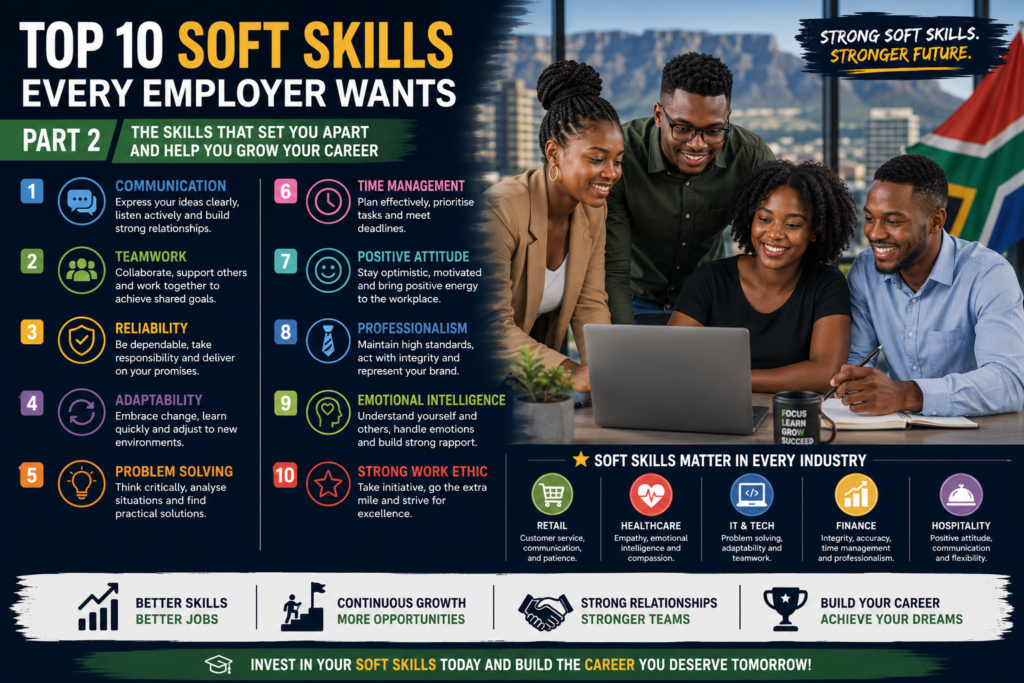
Now that we’ve explored what soft skills are and why they matter, it’s time to look at the specific qualities employers consistently look for when recruiting new employees.
Whether you’re applying for a position in retail, banking, healthcare, construction, hospitality, customer service, logistics, IT, or finance, these soft skills can significantly improve your chances of securing a job and progressing in your career.
The good news is that soft skills are not something you’re simply born with. They can be developed over time through experience, self-awareness, practice, and a willingness to learn.
Let’s explore the skills that employers value the most.
If you asked hiring managers to name the single most important soft skill, communication would almost always appear near the top of the list.
Communication is much more than speaking clearly. It involves listening carefully, asking relevant questions, understanding instructions, writing professional emails, explaining ideas, and interacting respectfully with colleagues and customers.
Almost every role requires communication.
A cashier communicates with customers.
A nurse communicates with patients.
A software developer communicates with project managers.
A warehouse employee communicates with supervisors.
Even if you rarely speak to customers, you’ll almost certainly need to communicate with colleagues throughout the working day.
Poor communication often leads to:
Strong communication, however, creates trust, improves teamwork, and helps businesses operate more efficiently.
You don’t need to become the loudest person in the room.
Instead:
During interviews, employers often evaluate communication from the moment they greet you.
Very few jobs are completed entirely alone.
Behind every successful business is a team of people working together towards shared goals.
Employers want people who contribute positively to the workplace rather than creating unnecessary conflict.
Good teamwork means:
A team player understands that everyone’s contribution matters.
For example, in a supermarket, cashiers, cleaners, shelf packers, supervisors, and managers all depend on each other to provide a positive customer experience.
If one person refuses to cooperate, the entire team may be affected.
Interviewers may ask questions like:
These questions help employers understand how you interact with others.
One of the most valuable employees isn’t always the smartest person—it’s often the person the employer knows they can count on.
Reliability means:
Think about it from an employer’s perspective.
If an employee regularly arrives late, misses deadlines, or frequently calls in absent, it affects productivity and places additional pressure on the rest of the team.
Reliable employees build trust quickly.
Managers know they can depend on them during busy periods or challenging situations.
Employers notice consistency.
The workplace changes constantly.
New technology, updated procedures, changing customer expectations, and evolving business priorities mean employees must be willing to learn and adapt.
Years ago, many jobs involved paperwork.
Today, much of that work happens digitally.
Employees who refuse to adapt often struggle.
Those who embrace change usually progress much faster.
Adaptability shows employers that you’re willing to:
This quality has become especially valuable as technology continues to evolve.
Employers appreciate people who see change as an opportunity rather than a problem.
Every workplace experiences challenges.
Equipment breaks.
Customers complain.
Orders are delayed.
Computer systems fail.
Employees who immediately panic create additional problems.
Strong problem-solvers remain calm, gather information, evaluate options, and work towards practical solutions.
Problem-solving doesn’t always mean having the answer immediately.
It often means asking the right questions and approaching challenges logically.
Problem-solving is one of the fastest ways to demonstrate leadership potential, even in entry-level roles.
Time is one of the most valuable resources in any business.
Employees who manage their time effectively help improve productivity while reducing stress.
Good time management involves:
Many employees become overwhelmed because they don’t organise their workload properly.
Learning how to prioritise tasks can dramatically improve both performance and job satisfaction.
Employers notice employees who consistently deliver quality work on time.
Professionalism influences how colleagues, managers, and customers perceive you.
It includes:
Professional employees represent both themselves and their employer positively.
Professionalism isn’t about wearing expensive clothes.
It’s about demonstrating maturity, integrity, and respect in every interaction.
Emotional intelligence refers to understanding your own emotions while recognising and respecting the emotions of others.
Employees with strong emotional intelligence often:
This skill is especially valuable in customer service, healthcare, education, hospitality, and leadership positions.
People enjoy working with emotionally intelligent colleagues because they create positive workplace environments.
Employers appreciate employees who approach challenges with enthusiasm and optimism.
A positive attitude doesn’t mean pretending everything is perfect.
Instead, it means focusing on solutions rather than constantly complaining about problems.
Positive employees often:
Attitude can influence an entire team’s morale.
Managers notice employees who contribute positively to workplace culture.
A strong work ethic combines many of the previous soft skills into one overall approach to work.
Employees with strong work ethics:
Employers invest in people they believe will contribute consistently over many years.
A strong work ethic demonstrates commitment, reliability, and professionalism.
Although every employer values soft skills, certain industries place greater emphasis on specific qualities.
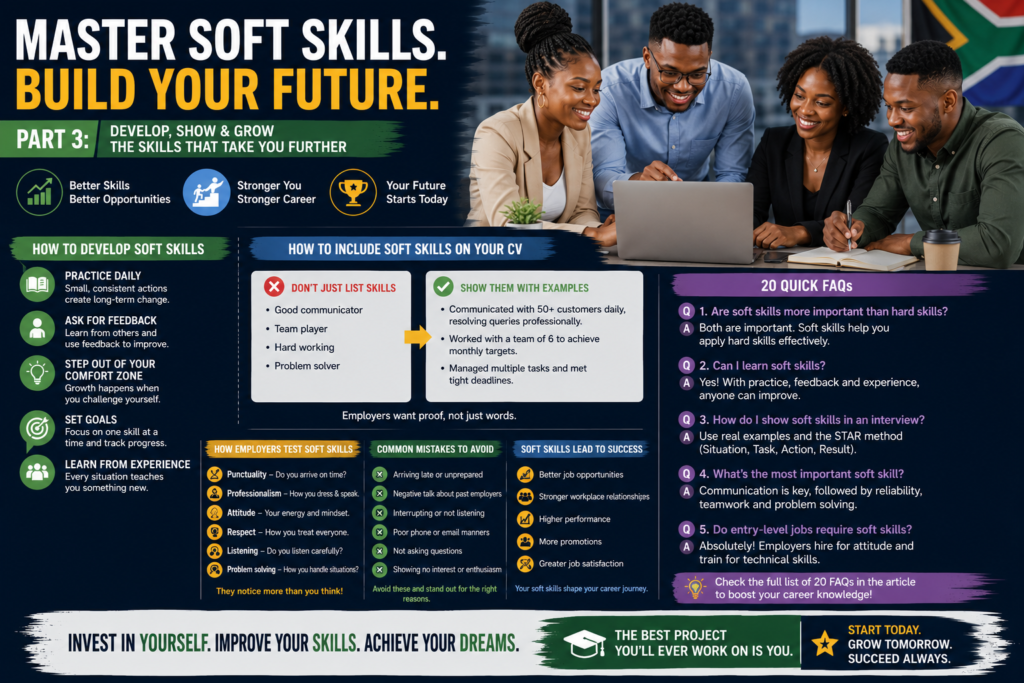
Understanding what soft skills are is only the first step. The next challenge is learning how to develop these qualities and, just as importantly, how to demonstrate them when applying for jobs.
Many job seekers make the mistake of simply listing soft skills on their CV without providing any evidence. Writing “excellent communication skills” or “strong leadership abilities” means very little if you can’t support those claims through your experience, behaviour, or examples during an interview.
Employers don’t just hire people who say they have soft skills—they hire people who consistently demonstrate them.
In this final section, we’ll look at practical ways to improve your soft skills, explain how employers assess them throughout the recruitment process, and show you how to present them effectively on your CV and during interviews.
Absolutely.
One of the biggest misconceptions is that people are either naturally good communicators, leaders, or team players—or they aren’t.
The truth is that soft skills can be developed throughout your life.
Just like learning to drive a car or use new software, becoming a better communicator or improving your time management requires practice, patience, and consistency.
The more you actively work on these skills, the more natural they become.
For example:
Every small improvement helps you become a stronger professional.
Communication is one of the easiest soft skills to improve because you practise it every day.
Here are a few practical ways to become a better communicator:
Many people focus on what they want to say instead of paying attention to the person speaking.
Active listening shows respect and helps you understand instructions correctly before responding.
Reading books, newspapers, and professional articles expands your vocabulary and improves both your written and verbal communication.
Whether you’re speaking to customers, colleagues, or interviewers, take your time and speak confidently rather than rushing your words.
Professional emails should always be polite, clear, and free of spelling mistakes.
Simple improvements in written communication often leave lasting impressions.
Working well with others doesn’t mean agreeing with everyone all the time.
Instead, it means contributing positively while respecting different ideas and personalities.
Ways to improve teamwork include:
Employers value employees who strengthen teams rather than create unnecessary conflict.
A strong work ethic is something you demonstrate every single day.
You build your reputation through consistency.
Simple habits include:
Managers quickly notice employees they can depend on.
These employees are often the first considered for promotions and additional responsibilities.
Time management isn’t about working faster—it is about working smarter.
Start by planning your day before you begin working.
Ask yourself:
Using calendars, reminders, and daily task lists can significantly improve productivity while reducing unnecessary stress.
Today’s workplace changes rapidly.
New technology, updated systems, and changing customer expectations require employees who can learn continuously.
To become more adaptable:
Adaptable employees remain valuable even as industries evolve.
Many people believe the interview is the only time employers evaluate candidates.
In reality, your assessment often begins long before the interview starts.
Recruiters notice things such as:
Is it organised?
Free of spelling mistakes?
Easy to read?
Was your application polite and professional?
Did you follow instructions?
Were you respectful?
Did you answer professionally?
Were you punctual?
Did you arrive prepared?
One interesting fact that surprises many job seekers is that some employers ask receptionists for feedback after interviews.
How you treat everyone—not just the interviewer—can influence hiring decisions.
Always be polite, respectful, and professional.
Rather than simply listing soft skills, show employers where you’ve used them.
For example:
❌ Poor Example
These statements are vague and don’t provide evidence.
A stronger approach is to describe achievements.
✅ Better Example
These examples demonstrate soft skills through actions rather than simply claiming to possess them.
Employers often ask behavioural questions because they want examples from your past experiences.
Examples include:
A useful technique for answering these questions is the STAR Method:
This keeps your answers structured and easy to follow.
Even qualified candidates sometimes miss opportunities because of avoidable mistakes.
Some of the most common include:
Avoiding these mistakes can improve the impression you leave.
Soft skills don’t just help you get hired—they help you grow.
Many employees begin in entry-level roles but eventually move into supervisory or management positions because they consistently demonstrate:
These qualities help build trust, and trust is often the foundation of career advancement.
Soft skills are personal qualities and interpersonal abilities that influence how you communicate, work with others, solve problems, and manage your responsibilities.
Because they contribute to stronger teamwork, better customer service, improved productivity, and healthier workplace relationships.
Both matter. Qualifications help you meet job requirements, while soft skills often determine how effectively you perform and grow within the role.
Yes. Through practice, feedback, learning, and experience, anyone can strengthen their soft skills over time.
Communication is consistently ranked among the most valuable because it affects almost every aspect of work.
Through your CV, emails, interviews, punctuality, professionalism, behaviour, and interactions throughout the recruitment process.
Yes, but wherever possible, support them with examples of how you’ve demonstrated those skills in previous roles or projects.
Absolutely. Employers often hire entry-level candidates based on attitude, reliability, and willingness to learn.
Yes. Leadership, teamwork, professionalism, and problem-solving are often key factors when employers consider promotions.
Every industry does. Whether you work in retail, healthcare, IT, education, hospitality, construction, finance, or government, strong soft skills contribute to long-term success.
Qualifications may help you open the door to an opportunity, but it’s your soft skills that often determine how far you’ll go once you’re inside.
Every conversation, every project, and every interaction gives you the chance to build trust, demonstrate professionalism, and show employers that you’re someone they can rely on. Technical knowledge will always be important, but qualities like communication, integrity, adaptability, teamwork, and a strong work ethic are what turn good employees into exceptional ones.
The best part is that soft skills are not fixed—they can be developed throughout your career. By making a conscious effort to improve how you communicate, manage your time, solve problems, and work with others, you’ll not only increase your chances of getting hired but also create a strong foundation for long-term career growth.
Whether you’re applying for your first job or aiming for your next promotion, investing in your soft skills is one of the smartest decisions you can make. Employers are looking for people who bring more than qualifications to the workplace—they’re looking for people who can make a positive difference every day.








 📢 Get Job Alerts on WhatsApp
 Home
Home View all posts
 Post a Job