 JobTime
Finding a job is important, but building a successful career involves much more than sending out applications and waiting for an employer to respond. Your career can develop over many years, and the decisions you make today can influence the opportunities available to you in the future.
Whether you have recently finished school, are currently unemployed, want to change careers, or simply feel stuck in your current position, having a clear career strategy can help you move forward.
The South African job market can be competitive. Hundreds or even thousands of people may apply for certain opportunities. This can make job hunting frustrating, especially when applications receive no response.
However, there are practical steps you can take to improve your chances.
You do not necessarily need to have everything figured out immediately. Careers are rarely perfectly planned from the beginning. People learn new skills, change industries, discover new interests and sometimes take unexpected opportunities.
What matters is that you continue developing yourself and making informed career decisions.
This guide explores practical career advice that South African job seekers can use to improve their employability, strengthen their applications and build a career with long-term potential.
When you are unemployed, finding any source of income can understandably become the priority. However, whenever possible, think beyond your next job.
Ask yourself:
Where could this opportunity take me in two or three years?
For example, an entry-level administrative position may not be your dream job, but it could help you gain experience with office administration, customer communication, spreadsheets, reporting and business systems.
Those skills could eventually help you qualify for positions such as:
Your first position does not have to be your final destination.
Sometimes a job should be viewed as the first step on a longer career ladder.
Before applying for an opportunity, consider what experience you could gain from it and whether that experience could make you more employable later.
Many job seekers focus entirely on what they want from an employer.
Salary.
Benefits.
Working hours.
Location.
Job title.
These things matter, but employers are looking at the situation from another perspective.
They are asking:
What can this person contribute to our organisation?
Your CV and application should help answer that question.
Employers generally want people who can solve problems, follow instructions, communicate effectively, work with others, learn quickly and complete their responsibilities reliably.
Technical qualifications may get your application noticed, but your behaviour and attitude can also influence whether you succeed.
This is why employers frequently mention qualities such as:
Do not dismiss these as meaningless phrases in job advertisements.
Think about situations where you have demonstrated these abilities and be prepared to discuss them during an interview.
One of the biggest mistakes you can make during unemployment is allowing months to pass without developing yourself.
You may not be able to control when an employer hires you, but you can control what you learn while searching.
There are many skills that can improve your employability.
Depending on your career interests, these could include Microsoft Word, Excel, customer service, bookkeeping, digital marketing, coding, graphic design, administration, project management or communication.
You do not necessarily need to enrol in an expensive qualification every time you want to learn something.
Online learning platforms, tutorials, short courses and practical projects can help you build knowledge.
The important part is to actually practise.
Watching ten hours of Excel tutorials is useful, but opening Excel and creating your own spreadsheets is better.
If you want to work in social media, create sample social media campaigns.
If you want to become a writer, create articles.
If you want to work in graphic design, build a small portfolio.
If you want an administrative career, practise professional emails, spreadsheets and document formatting.
Skills become more valuable when you can demonstrate them.
Sending the same CV to every employer may seem convenient, but it can reduce your chances of getting noticed.
Different jobs require different skills.
Imagine you are applying for both a cashier position and an administrative assistant position.
The cashier vacancy might emphasise:
The administrative vacancy might emphasise:
You may have experience relevant to both positions, but the most important information should change depending on the vacancy.
Read the job advertisement carefully before applying.
Identify the qualifications, experience and skills the employer repeatedly mentions.
Then make sure your CV clearly shows your relevant experience.
This does not mean lying or adding skills you do not possess.
It means presenting your genuine experience in a way that is relevant to the position.
Your CV does not need complicated graphics to impress an employer.
In many cases, clarity is more important.
A recruiter should be able to quickly understand who you are, what experience you have and what skills you offer.
A practical CV can include:
Personal details
Your name, contact number, email address and general location.
Professional summary
A short introduction explaining your experience, strengths and career goals.
Work experience
List relevant employment history, normally starting with your most recent position.
Include your job title, employer and major responsibilities.
Education
Include your relevant qualifications and educational background.
Skills
Mention skills that genuinely apply to you and the position.
References
You can include references when appropriate or state that references are available upon request.
Always check your spelling, contact information and formatting before submitting your CV.
A small mistake in your telephone number or email address could prevent an employer from contacting you.
It is easy to fall into the habit of applying for every vacancy you see.
You may think:
The more applications I submit, the better my chances.
There is some truth to applying consistently, but application quality matters.
Sending 100 poorly matched applications is not necessarily better than sending 20 carefully prepared applications for positions where you meet most of the requirements.
Before applying, check:
If the advertisement asks you to include a particular reference number in the subject line, do it.
If it asks for specific documents, provide them when appropriate.
Following instructions is itself a demonstration of attention to detail.
There is another side to the previous advice.
You should apply strategically, but you should not reject yourself simply because you do not meet every preferred requirement.
Job advertisements sometimes describe an ideal candidate.
If you meet most of the important requirements and believe you could perform the job, it may still be worth applying.
Let the employer decide whether your experience is sufficient.
This is particularly important when requirements are described as preferred rather than mandatory.
There is a difference between being completely unqualified and missing one preferred skill.
Be realistic, but do not underestimate yourself.
Getting invited to an interview means the employer has already seen something they like in your application.
Now they want to learn more about you.
Do not arrive without preparation.
Before the interview, research the employer and understand what the company does.
Read the vacancy again.
Think about why you applied.
Prepare examples of your experience.
You may be asked questions such as:
Tell us about yourself.
Give a short professional introduction rather than your entire life story.
Why do you want this job?
Explain what interests you about the opportunity and how your skills relate to it.
What are your strengths?
Choose strengths that are relevant to the position and provide examples where possible.
Tell us about a difficult situation you handled.
Explain the situation, what you did and what happened.
Why should we hire you?
Connect your experience, attitude and abilities to the employer’s requirements.
Practising answers can make you more confident, but avoid memorising every sentence.
You want to sound prepared, not robotic.
Your professional reputation begins before you receive an important job title.
People remember whether you are reliable.
They remember whether you arrive on time.
They remember how you speak to colleagues and customers.
They remember whether you complete your responsibilities.
A good professional reputation can create opportunities.
A former colleague may recommend you for another position. A manager may contact you about a vacancy. A customer may eventually become a professional connection.
Treat even temporary or entry-level positions seriously.
You never know which relationship could help your career later.
Networking does not mean asking everyone you meet for a job.
Good networking means building genuine professional relationships.
Tell trusted friends, former colleagues and professional contacts that you are looking for opportunities.
Connect with people in industries that interest you.
Attend career events when available.
Participate professionally on platforms such as LinkedIn.
Ask people about their careers and learn from their experiences.
A simple conversation can sometimes introduce you to an industry or opportunity you had never considered.
However, avoid sending strangers demanding messages asking them to hire you.
Build relationships respectfully.
Unfortunately, people searching for employment can be targeted by scammers.
Desperation for work can make job seekers vulnerable because scammers know people may act quickly when they see an attractive opportunity.
Be cautious when a supposed employer asks you for money.
Research unfamiliar companies.
Check email addresses and websites carefully.
Be suspicious of offers that appear unrealistic, particularly when you are offered a job without a proper recruitment process.
Also be careful when sharing sensitive personal information.
Legitimate recruitment processes may require personal information at certain stages, but you should understand who you are dealing with and why the information is required.
Never allow the excitement of a potential job to override basic caution.
Strong communication can benefit almost every career.
This includes how you speak, write emails, listen to instructions and communicate problems.
Professional communication does not mean using complicated words.
It means being clear and respectful.
For example, instead of sending an employer:
“Hi did u see my cv???”
a more professional message would be:
“Good morning. I am following up regarding my application for the Administrative Assistant position submitted on 18 August. Please let me know if you require any additional information. Thank you for your time.”
Small differences in communication can affect how people perceive your professionalism.
Practise writing clearly.
Read your messages before sending them.
Digital skills are becoming increasingly important across many industries.
Even jobs that were previously mostly manual or paper-based may now involve digital systems.
You may need to use:
You do not need to become a computer expert overnight.
Start with the tools most relevant to the jobs you want.
If job advertisements in your preferred field repeatedly ask for Excel, that is a strong indication that learning Excel could improve your employability.
Pay attention to patterns in vacancies.
Job advertisements can effectively tell you which skills the market values.
Do not rely entirely on your memory.
Keep a record of important accomplishments throughout your career.
For example:
These details can later help you update your CV and prepare for interviews.
Instead of simply writing:
“Responsible for customer service.”
you may eventually be able to provide stronger evidence of what you achieved in the role.
Specific achievements can make your experience easier for employers to understand.
Receiving a job offer should not be the end of your career development.
Once employed, pay attention to how the organisation works.
Learn from experienced colleagues.
Ask sensible questions.
Volunteer for responsibilities that can teach you valuable skills when appropriate.
Understand which positions exist above yours and what qualifications or experience those positions require.
If you are a cashier and want to become a supervisor, find out what supervisors are expected to know.
If you are an administrator and want to enter HR, learn which HR skills and qualifications employers require.
Your current workplace can become a training ground for your next career step.
Salary is important. People work because they need to support themselves and their families.
However, when comparing opportunities, salary should not always be the only consideration.
Suppose Job A pays slightly more but offers almost no opportunity to learn or advance.
Job B pays slightly less initially but provides valuable training, experience and a realistic path toward promotion.
Depending on your financial circumstances, Job B could potentially create greater long-term value.
Consider the full opportunity:
A career decision should ideally consider both your immediate needs and your future.
Job rejection can be difficult, especially after submitting many applications.
You may spend hours preparing an application, attend an interview and still receive a rejection.
Sometimes you may receive no response at all.
Try not to interpret every rejection as proof that you are incapable.
Recruitment decisions can involve many factors.
Another applicant may have more experience. The company may hire internally. The position may change. Hundreds of people may have applied.
Where possible, evaluate what you can improve.
Was your CV relevant?
Did you prepare for the interview?
Do you need another skill?
Are you applying for jobs that match your experience?
Learn what you can, make adjustments and continue.
Saying “I want a better career” is a good intention, but it is difficult to measure.
Turn broad goals into actions.
For example:
This month I will update my CV.
I will apply for five suitable vacancies each weekday.
I will complete an Excel course within six weeks.
I will improve my LinkedIn profile this weekend.
I will research three career paths related to my current experience.
These goals give you something specific to work toward.
Your career may take years to develop, but progress happens through smaller actions.
It is useful to have direction.
Perhaps your plan is:
Receptionist → Administrator → Senior Administrator → Office Manager
Or:
Retail Assistant → Supervisor → Assistant Manager → Store Manager
Or:
General Worker → Machine Operator → Team Leader → Production Supervisor
Having a possible path can help you identify the skills you need next.
But do not become so attached to one plan that you ignore good opportunities.
Industries change.
Your interests may change.
New careers may emerge.
You may discover that you are good at something you never originally considered.
A career plan should provide direction, not trap you.
Employers increasingly operate in a digital environment, which means your online presence can form part of your professional image.
Review what is publicly visible about you.
Your personal social media accounts do not need to look like corporate advertisements, but think carefully about content that could seriously damage your professional reputation.
For professional platforms, keep your information accurate and updated.
Your online profile can highlight your:
You can also follow organisations and professionals in industries that interest you.
Use the internet as a career-building tool, not only for entertainment.
It is easy to look at someone your age and feel that you are behind.
Someone may already own a house.
Someone may have become a manager.
Someone may have completed a degree.
Someone may appear extremely successful online.
You do not know their complete circumstances.
Constant comparison can distract you from improving your own situation.
Instead, compare yourself with where you were previously.
Have you learned something new?
Is your CV better?
Are you gaining experience?
Are you becoming more confident?
Are you making better career decisions?
Progress does not always happen at the same speed for everyone.
Many people want the salary and position of someone with five years of experience before they have had the opportunity to build that experience.
Everyone has to start somewhere.
An internship, learnership, temporary position, entry-level job or junior role can sometimes provide the experience required to reach better opportunities.
This does not mean accepting exploitation or ignoring your value.
It means recognising that experience itself can have long-term value.
When evaluating an entry-level opportunity, ask:
What can I learn here?
What experience will I have after one year?
Will this make me more employable?
If the answers are positive, the opportunity may be worth considering.
Loyalty can be valuable, but remaining in a position indefinitely without learning, progressing or improving your circumstances may not always be best for your career.
Periodically evaluate your situation.
Ask yourself:
You do not need to leave a job simply because something else exists.
However, you should remain aware of your career direction.
Make career moves thoughtfully rather than impulsively.
Career plans do not always work exactly as expected.
Perhaps you cannot afford university right now.
That does not necessarily mean abandoning your career goal.
There may be other routes involving short courses, learnerships, internships, workplace experience, part-time study or entry-level employment.
Suppose your long-term goal is management.
You might begin in customer service, administration, retail or operations and gradually take on leadership responsibilities.
The path may not be perfectly straight.
What matters is continuing to build relevant skills and experience.
If you are actively unemployed, create a routine around your job search.
Instead of randomly checking vacancies throughout the day, organise the process.
For example, you could spend time each morning:
Keep a simple application tracker containing:
This prevents confusion when employers contact you.
If someone phones and says, “We’re calling regarding your application,” you should ideally know which position they mean.
Organisation makes the job search more manageable.
A useful career question is:
What can I learn this year that will make me more valuable next year?
Your earning potential and career opportunities can improve when you develop skills that organisations need.
That could mean becoming better at sales, learning a software system, improving your communication, obtaining a qualification, learning a trade or developing leadership experience.
You do not need to transform your entire career in one month.
Consistent improvement compounds over time.
Learning one useful skill may help you qualify for a new responsibility.
That responsibility gives you experience.
The experience strengthens your CV.
The stronger CV helps you qualify for another opportunity.
Careers often grow through this type of progression.
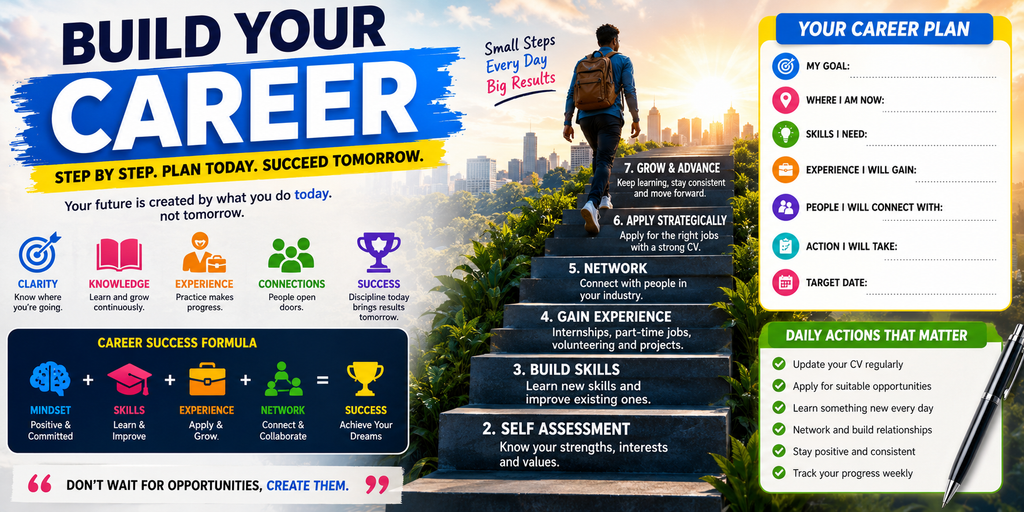
Building a successful career is not about having your entire future figured out today.
It is about continuously improving your position.
Start with what you have.
Improve your CV.
Develop relevant skills.
Apply for suitable opportunities.
Prepare properly for interviews.
Build professional relationships.
Protect yourself from scams.
Learn from rejection.
Take entry-level opportunities seriously.
Continue developing yourself after you become employed.
Most importantly, think beyond simply getting a job.
Think about what each opportunity can teach you and where that experience could lead.
Your career may include unexpected changes, setbacks and periods when progress feels slow. That does not mean you should stop developing yourself.
A person who continues learning, gaining experience and adapting can create new opportunities over time.
You may not be able to control every hiring decision, but you can control how prepared you are when the right opportunity appears.
Take your career one step at a time, continue building your skills and remain open to opportunities that can move you closer to the future you want.
Disclaimer: JobTime provides general career and job-search information for educational purposes. Job opportunities, requirements and recruitment processes differ between employers. Always verify vacancies and application requirements directly with the relevant employer or recruitment platform before submitting personal information.








 📢 Get Job Alerts on WhatsApp
 Home
Home View all posts
 Post a Job